





Travelers along Highway 6 are treated to stunning views of the rolling Willapa Hills, picturesque forests, and one unusual stop that is a don’t-miss when driving out to the coast. Just outside of Lewis County, between Menlo and Raymond, sits a grave with a remarkable, strange story. At Willie Keil’s Grave State Park Heritage Site along the state route, this quirky monument commemorates the “Pickled Pioneer.”

The Golden Rule Bethelites
Dr. Wilhelm Keil emigrated from Germany to the United States in the 1830s and by 1844 formed a colony of 200 with a central focus on the “Golden Rule” of reciprocity in Bethel, Missouri. With 6,000 acres, the highly self-sufficient community manufactured wagons and distilled “Golden Rule Whiskey.”
In the 1850s, Wilhelm Keil, as a charismatic leader, persuaded the Bethelites to establish a new colony in the west, where it could acquire land and expand its enterprises. That year, colony member Christian Giesy, his wife Emma, and seven other brave souls set out to scout a suitable location across the Oregon Trail. The group ultimately selected land in the Willapa River Valley of present-day southwest Washington.

The Short Life of Willie Keil
Wilhelm’s 19-year-old son, Willie, fiercely supported the migration plan, and his father promised he could drive the lead wagon. Shortly before the group’s departure, Willie fell ill and was diagnosed with malaria. Sadly, the young man died just four days before the journey was to begin. On Willie’s deathbed, Wilhelm renewed his promise that his son would lead the wagon train.
Determined to keep his word, Wilhelm purchased a zinc coffin for his son in St. Louis, filled with the whiskey the colony was known for, and carried him more than 2,000 miles across the frontier. The result was one of history’s longest and most unusual funeral processions.
Along the way, Native American tribes reportedly gave the unusual procession safe passage out of respect for Willie. His epic final road trip ended on November 26, 1855, when he was buried in the evening by candlelight on a hill overlooking today’s heritage site. And thanks to his whiskey-powered preservation, Willie rolled into history with an unforgettable nickname, as the “Pickled Pioneer.”
Ultimately, when the group reached the Willapa River Valley that rainy late fall, Wilhelm Keil immediately disliked the site, saying, “Our clothes and our shoes actually rot on our bodies because of the mud and wetness.” So, Wilhelm Keil backtracked to the Willamette Valley and founded the Aurora Colony, which became one of the Pacific Northwest’s most successful and enduring utopian communities.
But Willie remained in his grave, situated among trees on the hill above today’s heritage site, which was the cemetery’s first burial. The Giesy family has maintained the cemetery, and most Giesy family members who settled in the Willapa River Valley were later buried there, alongside the Pickled Pioneer.
Aurora remained a communal utopian settlement until 1883. After Wilhelm died unexpectedly in 1877 without a clear succession plan, the colony’s land was transferred to individual owners, and the settlement eventually became the town of Aurora, Oregon.

Willie Keil’s Grave State Park Heritage Site Features
Created in 1959, the 0.34-acre heritage site includes a highway pullout where you can safely stop, take photos, and learn more about the story of the Pickled Pioneer. Visitors will find several interpretive panels and heritage markers that bring Willie’s unusual story and the Bethelite migration to life. Willie Keil’s grave rests in a small private cemetery on a hill above the site, so while you will need to view Willie’s final resting place from afar, the highway viewing area is worth a quick stop for a peculiar roadside stop.
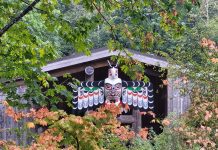
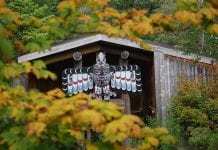
In 2020, new interpretive panels were installed to replace an old wooden marker that shared Willie’s story. See the original marker by notable woodcarver Dudley Carter at the Northwest Carriage Museum in Raymond, where you can also explore the collection of horse-drawn vehicles and 19th-century period artifacts.
The site is also a link to the Willapa Hills Trail, so hikers and cyclists can join the adventure with one quick highway crossing. Don’t let parking pickle your plans, as a Discover Pass is required at Washington State Parks. It’s a day-use-only area, so no overnight parking is allowed and there are no restroom facilities. Plan your stop during daylight hours, as the spot is open from 8 a.m. until dusk.
Willie Keil’s grave may be a small landmark, but it tells one mighty story. It’s worth the time to discover a young pioneer’s extraordinary final journey, a father’s promise, and the community determined to carry his dream westward all the way to Washington.
Willie Keil’s Grave State Park Heritage Site
753 WA-6, Raymond


